
 By
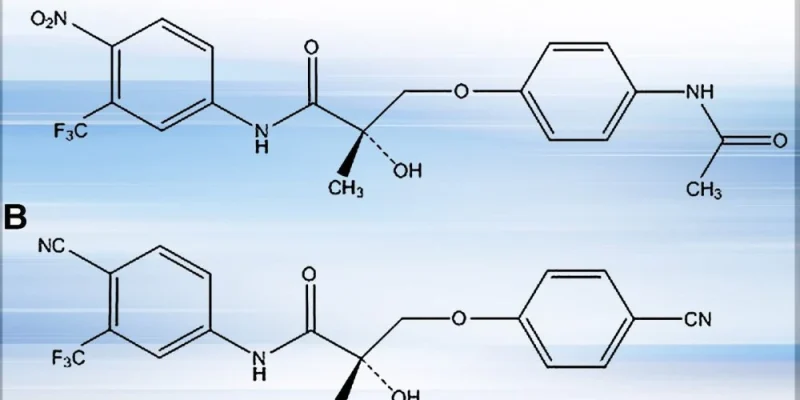
Two SARMs can share a shelf yet behave nothing alike. Chemical backbone, not marketing labels, decides how each compound binds. For labs sourcing sarms canada inventory, a structural lens brings welcome clarity. Scaffold families, trial records and mislabeled compounds shape fair comparisons. Each factor changes what a vial truly represents.
Scaffold Families Define Every SARM’s Identity
Researchers sort SARMs first by their core ring system.
- Aryl-propionamides include Ostarine and Andarine (S-4).
- Quinolinones gave rise to LGD-2226 and LGD-2941.
- Hydantoin derivatives produced Bristol-Myers Squibb’s BMS-564929.
- Pyrrolidine benzonitriles describe LGD-4033, known as Ligandrol.
- RAD140 relies on an oxadiazole-linked benzonitrile frame.
Why Do Nonsteroidal Structures Change Tissue Behavior?
Testosterone converts into DHT and estradiol through enzymes. Nonsteroidal SARMs resist aromatase and 5α-reductase entirely. As a result, prostate and breast tissue see weaker signaling. Selectivity also stems from receptor shape after binding. Once docked, each ligand twists the androgen receptor differently. That altered surface recruits distinct coactivator proteins in muscle versus prostate.
Clinical Trial Records Separate Serious Candidates
Enobosarm, also called Ostarine, reached Phase 3 cachexia trials. Later, Veru tested it against AR-positive breast cancer. LGD-4033 completed only Phase 1 safety work. Documented human data therefore varies enormously between compounds. Vendors offering sarms canada stock with batch purity reports earn trust.
Which Popular Compounds Are Not True SARMs?
Several best-selling research chemicals sit outside the androgen class.
- MK-677 mimics ghrelin’s growth hormone signal.
- Cardarine (GW501516) activates PPAR-delta receptors.
- SR9009 targets Rev-Erb clock proteins.
- YK-11 carries a steroidal, DHT-derived backbone.
Grouping these beside Ostarine muddles any structural comparison.
How Do Half-Lives Shape Study Design?
Pharmacokinetics divides compounds as sharply as chemistry does. In human trials, LGD-4033 showed a half-life near 24-36 hours. Andarine, by contrast, clears from rodent plasma in mere hours. Longer persistence suits extended tissue studies with fewer sampling gaps. Short-acting molecules favor tight time-course experiments instead.
Ring Systems Outlast Trendy Product Names
A vial labeled “SARM” could hold YK-11’s steroidal frame. Equally, it might contain RAD140’s oxadiazole-linked ring system. Chemically, those two molecules share almost nothing. Product names drift with marketing trends; CAS numbers stay fixed. Matching that registry code to a certificate anchors each label. Ultimately, a short string of digits outranks any slogan.
FAQs
Are SARMs approved for human use in Canada?
Health Canada has not authorized any SARM as a drug or supplement. Legitimate sales remain limited to laboratory research purposes.
What makes Ostarine the most studied SARM?
Enobosarm progressed further through clinical development than any rival compound. Its human dataset spans Phase 2 and Phase 3 programs.
Is LGD-4033 structurally related to RAD140?
Both contain a benzonitrile group, yet their core scaffolds differ. LGD-4033 builds on pyrrolidine, while RAD140 uses an oxadiazole linker.
Why does purity testing matter for research SARMs?
Independent analyses have found mislabeled and underdosed products on the market. HPLC and mass spectrometry confirm identity before any experiment begins.
Do SARMs suppress natural testosterone production?
Clinical data show dose-dependent drops in total testosterone and SHBG levels. LGD-4033’s Phase 1 trial recorded this effect after just 21 days.





Comments